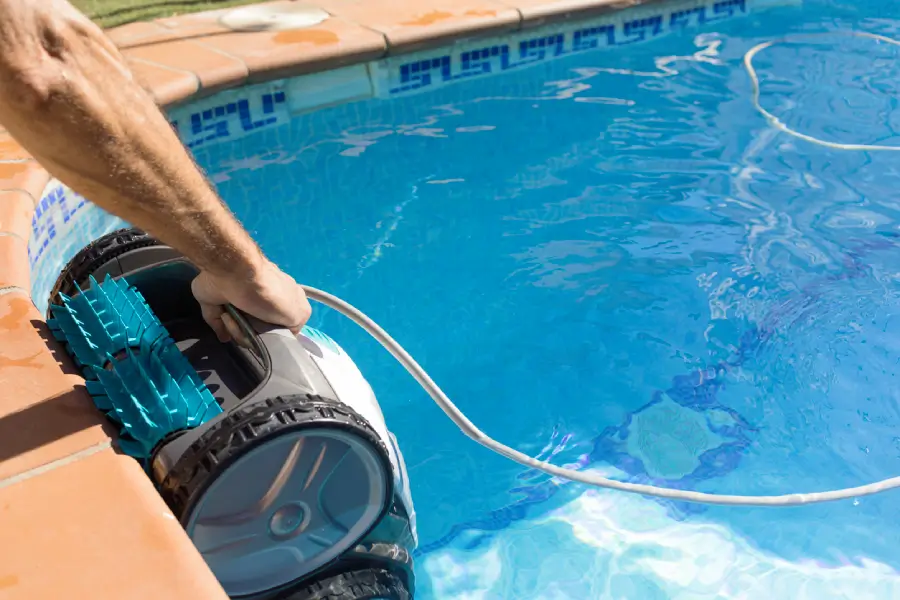
When looking at robotic cleaning systems, the filtering system is the key. This is the main function you're investing in, the capability to move around the pool but to actively remove pollutants and make your water sparkling clean. Understanding the subtleties of the different ways robots accomplish this will allow you to choose a model that solves your particular debris issues to ensure that you get the results you want.
1. The Cleaning Trinity.
It is important to understand that effective cleaning involves three parts. First, brushes should agitate to loosen the debris on the surface. Second, the debris must be immediately pulled into the collection device with a powerful vacuum. It is also crucial that the filtration traps and holds the debris in order to prevent it to recirculate. If one of these components is weak the performance of cleaning will be subpar. A robot that has strong suction and weak brushes will still leave behind a layer of algae that has been stuck on. A robot with good brushes, but not enough filtration, will only stir up dirt.
2. Brush Types: Their Particular Applications
Brushes are robots' tools to remove dirt. They should be constructed of a material that is both effective and safe for surfaces.
Stiff Bristle Brushes (Nylon) are designed for a scrubbing action that is aggressive on hard surfaces such as concrete, gunite and pebble Tec. These brushes are crucial to get rid of algae embedded and biofilm that adhere to the rough surface of the. Utilizing these on a vinyl liner can cause significant wear and scratching over time.
Vinyl or rubberized soft/rubberized brushes are the standard for vinyl liner, fiberglass pools and other swimming pool surfaces. These brushes provide excellent scrubbing without damaging softer surfaces. These products are safe and efficient for cleaning common dirt, debris and dirt.
Brushless Roller Systems - A more advanced technology. Instead of rotating brushes they employ textured rollers to help debris to the suction intake. They can be extremely effective in all types of pool and are more gentle than rotating brushes.
3. The critical importance of a Top-Loading Canister.
This is probably the most crucial feature. After lifting the robot out of the water, you are able to remove the filter cartridges from the top. This prevents the heavy filters that are stuffed with debris from falling into the bottom of the robot, splashing dirt on the deck or in the pool. This makes cleaning simple and easy.
4. From basic to advanced, you can filter media types.
The type of filter used determines the size of particles the robot will capture.
Standard Mesh Bags. Common on earlier or less sophisticated models of pools. They are efficient in collecting larger particles like leaves, twigs or other debris. They also permit finer silts and dust to pass and return back into the water.
Pleated Paper Cartridges (e.g. Dolphin's "Ultra-Fine") The latter is the most prestigious of robot-powered pool cleaners. These cartridges are large and feature a significant surface area. They are able to capture particles as small 2 microns, including dust, pollen and even algae spores. This level of filtration is the reason for the sparkling water that is found in high-end equipment. Filters are generally reusable.
Fine Micron Mesh cartridges are a viable alternative to pleated paper. Mesh of high-end quality is strong and is able to achieve the same levels of filtration as paper, however it may require more intense cleaning.
5. Filter Systems Specifically Designed for Debris Types
There are a variety of robots that have different filter options that suit the job.
For heavy leaf seasons the use of a large garbage bag or cage constructed of plastic is typically offered. It allows large volumes of large leaves to be gathered without having to empty the bag every few minutes.
Fine Filter Cartridges are used to clean up the weekly maintenance. They are designed to target small particles of sand and dust that can make water appear dull.
This is a crucial feature for pools with diverse sizes and types of debris.
6. Suction Power and water Flow rates.
The power of the pump onboard is the key to differentiation. Manufacturers seldom provide precise specs. With a more powerful suction, the robot can better take in massive debris (like sand), and also take debris out more effectively from the water. It is used in conjunction with the brushes. The strong suction will ensure that loose debris is sucked up immediately.
7. Active Brush Systems (vs. Passive.
This refers to the power source of the brushes.
Active Brushes (motor-driven brushes) The motor in the robot directs the brushes to turn. This gives a consistent, effective scrubbery action, regardless of robot movement speed. This method is the most efficient for cleaning walls and eliminating algae.
This brush system isn't motorized. It only rotates when the robot is able to pass over the surface of the pool. The system can agitate the water, however it's not as effective as a motorized brush.
8. Wall and Waterline Cleaning Technology
Not all robots are created equal. The basic models can only climb a wall. Advanced models use several techniques:
Boost Mode: When the robot senses that it's on a horizontal surface, it boosts suction speed and/or brushing power to make sure it doesn't slip.
Some models come with brushes that can rotate on walls in any direction, which can help improve cleaning.
Specialized Waterline Cleaning: The best robots will stop at the water's edge and scrub the area to eliminate any oily scum.
9. Cleaning Cycles, Patterns, and Programs
The filtering system will only clean up debris from the robot that it has brought to its intake. Navigation is a part of the performance.
Random Patterns: This can be unproductive as it could be unable to find certain spots, particularly in pools with complex patterns. It can also take longer to cover the entire area.
Smart, Systematic Patterns: (Grid scan or Gyroscopic). These patterns enable the robot to cover each inch of the swimming pool's surface in the least time possible. This guarantees that the pool's filtration system is able to cleanse it.
10. The relationship between robots and primary pool filtering.
A robotic cleaner can be described as an additional cleaner. It is used to clean pool surfaces (floors walls, walls, and waterline), then filters the debris into its self-contained bag/canister. The primary pump and filter system in the pool will be less stressed. Your primary filter will be in charge of filtering out dissolving particles and circulating chemicals. The robot won't operate your primary filter for an extended period of time each day. It will work with it to keep an optimally balanced and clean pool. See the top rated pool-reinigungstipps for site info including pool cleaner pool, swimming pool cleaners near me, pool store, a swimming pool, a swimming pool, pool skimming robot, pool cleaning systems, swimming pool service companies near me, pool cleaning product, cheap pool cleaners and more.

Top 10 Tips On How You Can Maximize The Performance Of Your Robotic Pool Cleaners In Terms Of Energy Efficiency And Power.
Understanding the energy efficiency of robots for cleaning your pool is crucial as it will directly impact your operating costs over time, and your environmental footprint and ease of use. Contrary to the older suction-side and pressure-side cleaners that depend on your pool's high-horsepower main pump, which is a major energy drainer, robotic cleaners are self-contained. They operate independently of a low-voltage motor with high-efficiency. The greatest benefit of these robots is that they help save enormous amounts of energy. But not all robots have the same capabilities. If you consider the details of power consumption and operating modes, along with necessary infrastructure, you'll be able to select the model that has the highest performance without consuming a lot of energy.
1. Independent Low Voltage Operation The primary benefit.
This is the basic idea. Robotic cleaners have their own motor and pump, which is powered by a separate transformer which is connected to an ordinary GFCI outlet. It operates using low voltage DC power (e.g. 32V 24V, 32V) that is more reliable and secure than operating the 1.5 to 2 HP main pump for hours at a time. This autonomy allows your robot to be operated without the need of your main pump.
2. Watts. Horsepower.
Knowing the size is crucial to understand the savings. The typical pump for a pool draws between 1,500 and 2,500 watts per hour. In contrast, a high-quality robotic pool cleaner consumes between 150 and 300 energy per hour throughout its cleaning cycle. This is a reduction in energy by around 90%. The running of a robot over a 3-hour cycle uses roughly the same amount of energy running couple of lightbulbs in a home at the same duration, when compared to the main pump, which is a big appliance.
3. The DC Power Supply/Transformer: Its Essential Role
It's not just an ordinary power cable. The black box that connects the outlet and the robot's cable is actually an intelligent transformer. It transforms 110/120V AC to DC power for the robot. The safety and efficiency of the robot depend on the performance of this component. It also houses the circuitry that controls programming cycles.
4. Smart Programming for Better Productivity.
The programming of the robot will directly impact the amount of energy it consumes. It's highly efficient to to select cleaning cycles.
Quick Clean/Floor only Mode: This cycle is run for a limited time (e.g. 1 hour) and only activates the program that cleans the floor using less energy than a regular cycle.
Full Clean Full Clean 2.5 to 3 hour normal cycle that gives you an efficient clean.
It is crucial to only use the energy you need to complete the task in hand, and avoid extended time.
5. Impact of Navigation of Energy Consumption.
The course of a robotic cleaner is directly related to its power consumption. The way a robot navigates that is random and "bump-and turn" is inefficient. It can take up to at least four hours to clean the pool in a random manner, consuming additional energy. A robot with systematic, gyroscopically-guided navigation cleans the pool in a methodical grid pattern, completing the job in a shorter, predictable timeframe (e.g., 2.5 hours), thereby using less total energy.
6. GFCI Outlets: Requirement, Location and Use.
In order to ensure complete security, it is essential to plug the robot's electrical supply into an Ground Fault Circuit Interrupter. These outlets include the "Test and Reset" buttons that are found in the majority of kitchens and bathrooms. The cleaner must be used only when there is a GFCI socket within the pool area. If not, an electrician should install one. The transformer should be placed at least 10 feet away from the pool's edge to protect it from splashes of water and other elements.
7. The length of the cable, its voltage drop, and Cable Length
The power that passes through the cable at low voltage can suffer a "voltage drop" when it is stretched over a long distance. Manufacturers have a limitation on the length of cable (usually 50-60 feet). In excess of this limit, the robot to perform poorly, move slowly or exhibit diminished capacity to climb. Always ensure the robot's cable is long enough to reach your pool's farthest distance from the outlet but do not use extension cords because they can cause voltage drop and are dangerous to your safety.
8. Comparing Efficiency to other cleaner types.
To justify the expense of an automated system, you have to know what it is being compared with.
These suction-side cleaners will be completely dependent on the pump you use. They make you operate the main pump for 6-8 hours per day, resulting in expensive energy bills.
Pressure-Side cleaners These are pressure-side cleaners that use the main pump, as well as a separate booster to add an additional 1-1.5 HP.
The robot's standalone efficiency makes it the most cost-effective choice over the long run.
9. The process of calculating operating costs
You can estimate the cost for operating your robot. The formula is: Electricity Rate ($/kWh) * (Watts/1000), hours used.
Example: A robot of 200 watts, running for 3 hours per day, 3 days a week, for $0.15 per Kilowatt.
(200W / 1000) = 0.2 kW. 0.2 9 hours per week equals 1.8 kWh. 1.8 kWh times $0.15 is $0.27 per week or approximately $14 per year.
10. Energy Efficiency is an Quality Marker
Generally speaking, the most advanced and effective motor technology correlates with a higher-quality product. A cleaner robot that operates more efficiently and thoroughly with less energy is often a sign of better engineering. It may also signify an engine that is more powerful, but still efficient. While a machine with a higher wattage may be more powerful, for example, to suction or climb, true effectiveness is derived from the combination of efficient cleaning as well as a swift, low-wattage cycling. It pays to invest in a model with a high-efficiency rating. You'll save money on utility bills every month for years. Check out the top productos para limpiar paredes de piscinas for blog advice including swimming pools in store, swimming pools in store, swimming pool for swimming, pool sweeper robot, aiper pool, robotic pool sweep, robot to clean the pool, technology pool, robotic pool cleaners for above ground pools, swimming pools stores and more.